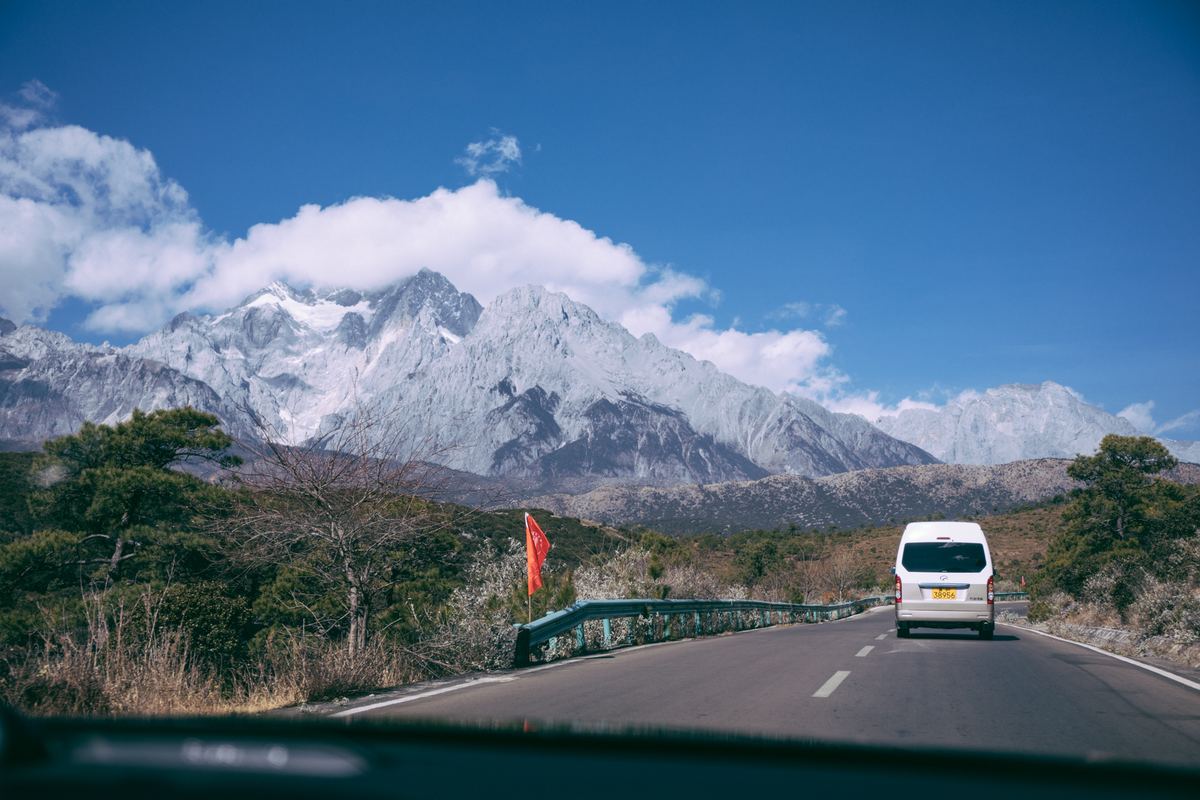
I’ll own the mistake straight away. One bright, cold November I took a rugged 4x4 for a run that was almost all paved road, grinned at the height, then watched the mileage allowance become the least amusing part of the trip. The view was glorious. The maths was not.
That is the trap on a six-day Dali and Lijiang loop: an SUV feels right for Yunnan, but a lighter saloon often suits the actual driving. This is local Yunnan self-drive rental for foreigners — you fly into China and pick up a car here. If you land in Kunming, Kunming airport car rental for foreigners is a sensible starting point; you can also arrange pickup or return at a city office.
The two cars that matter for six days
Through Yunnan Province International Travel Agency (Group) Co., Ltd, the practical choice is between a VW Lavida 1.5L or Jetta 1.4T petrol saloon at RMB 260 a day, and a Tank 300 2.0T at RMB 400 a day. No electric vehicles are on offer, which I don’t mind in the hills.
The saloons come with unlimited mileage and a rental deposit of RMB 3,000. The Tank 300 has a RMB 5,000 deposit and a 300 km per day limit.
Before anyone writes in: yes, I know the Tank looks the part. Boxy stance, high seating, the quiet confidence of a vehicle that thinks every village lane is a negotiating position. But unless your route genuinely needs that bulk, you may be paying for posture.
What six days do to the bill
At the daily rate alone, the saloon is RMB 1,560 for six days. The Tank is RMB 2,400. That gap already buys several decent dinners, and it does not include the different deposit or any extra mileage charge if you go beyond the cap.
I’d choose the Lavida or Jetta for Dali old town, Erhai’s paved roads, the motorway and trunk roads towards Lijiang, and the usual tourist stretches. They are easier to park, calmer in tight town traffic, and the unlimited mileage removes that dull background calculation every time you decide to take one more viewpoint road.
I’d look at the Tank if your plans include rough highland tracks, fully loaded luggage, or that particular mood where sitting higher makes everyone in the party believe they are a mountaineer. Fair enough. Just plan around the 300 km daily limit rather than pretending it does not exist.
Dali to Lijiang, and why I used to overbuild the trip
The well-trodden Yunnan runs are around Kunming, Dali, Lijiang and Shangri-La. For six days, many people do Dali and Lijiang without trying to swallow Shangri-La as well. That restraint is underrated.
My own bad habit was treating the itinerary like a stamp collection. Dawn light over Erhai? Yes. Coffee in Xizhou? Obviously. Lijiang before lunch? Somehow. Then a viewpoint, then another road, then a confused argument with a navigation prompt while the fuel gauge gave me the look.
On one crisp morning, the tarmac was dark after a short shower and the saloon I was driving tracked cleanly through the bends. Nothing dramatic happened, which is exactly the point. I had expected mountain motoring to demand a larger vehicle; the road was asking for patience, not armour. I came back converted to unlimited mileage, because wandering is the whole holiday until the moment it appears on an invoice.
One-way return is convenient, not free
If you pick up in Dali and return in Lijiang, or arrange a similar one-way finish, there is a one-way return fee of RMB 1,500. It can still be the sane call — backtracking after six days can waste a full day of fresh scenery and goodwill — but decide early. A loop often suits the saloon budget; a point-to-point route suits people who value not retracing their tarmac.
Licence paperwork: don’t wing it
Foreign visitors should not assume an overseas permit is enough in China. A China temporary driving licence can be arranged for RMB 1,500, and you do not need to attend in person. Contact Zara ahead of travel, because turning up at an airport desk with a suitcase and optimism is not document planning.
The agency’s details are simple:
- WeChat / WhatsApp: +86 13759155671
- WeChat ID: qxzj7557
- Email: [email protected]
I’d message before booking flights if your dates are tight. Send names, dates, pickup and return locations, and whether you want the saloon or SUV. Then you are not translating licence questions in an airport car park while the高原 sun makes the phone screen unreadable.
Deposit, insurance and the scratch conversation
The rental deposit is RMB 3,000 for the saloon or RMB 5,000 for the Tank. It is refunded 5–7 working days after return, once the traffic-fine check is complete. That is normal, but keep enough room on your card so the temporary hold does not spoil the last dinner.
Insurance includes compulsory and commercial cover. The scratch rules are worth reading before you drive off, not after someone parks by feel in a narrow Lijiang lane:
- Minor scratches under RMB 1,500 are paid by the client.
- Scratches that do not damage the primer are free.
- Damage above RMB 1,500 goes through insurance, with the client bearing 30%.
- No downtime or depreciation charges apply for paintwork or replaced parts.
- For major damage, downtime is waived within 5 days.
That last bit matters more than people think. A rental desk can become very serious once a vehicle is off fleet; here the rules are set out rather than discovered through panic.
If the vehicle breaks down for a mechanical reason, the agency covers it. If towing is needed for a client-caused reason, that cost is the client’s. Translation: don’t test ground clearance like a rented donkey. If you choose the saloon, stay on roads that suit a saloon.
The booking deposit is RMB 600 and is non-refundable if you cancel for personal reasons. I don’t resent that, provided I’m sure of dates. I do resent booking in a fit of enthusiasm and later pretending weather forecasts are a moral issue.
Pickup, parking and the five-minute ritual that saves money
Airport pickup is easy after a long flight, which is precisely when your judgement is weakest. Do the slow walk around the car. Photograph every panel. Check the wheels. Note primer damage. Point things out before you drive away, not when you return and the light has changed.
Parking in Dali and Lijiang rewards smallness. Old-town edges, hotel courtyards and viewpoint lay-bys are often tighter than navigation suggests. The Tank has presence; a Lavida has discretion. After twenty-odd years of overland travel, I’ve learned that discretion frequently parks closer.
Navigation is straightforward on main roads, but allow extra time for town approaches, coach traffic and the occasional road closure that everyone local already knows about. Carry water, not because this is an expedition, but because plateau sun and delayed lunch make couples argue about directions.
My call for a six-day trip
If the route is Dali, Erhai, Xizhou, Lijiang and the standard paved excursions, take the unlimited-mileage saloon. It costs less per day, carries the smaller deposit, and lets you detour without auditing every kilometre.
Choose the Tank 300 only when the route justifies the higher daily rate, the larger deposit and the 300 km daily cap. Wanting it because it looks capable is not a crime, but call it what it is.
Messaging Zara on WeChat or WhatsApp is the quickest way to settle vehicle availability, the temporary driving licence, airport pickup and whether that RMB 1,500 one-way return fee fits your plan. Then pack light, check the car carefully, and leave enough slack in the day to stop somewhere unplanned. That is usually where the good bit happens.
Zara
Yunnan Province International Travel Agency (Group) Co., Ltd
WeChat/WhatsApp: +86 13759155671
WeChat ID: qxzj7557
Email: [email protected]