Route overview
Cross the Qinling from Xi'an into Hanzhong and sleep first at Mian County for the Marquis Wu shrine and Dingjun Mountain; head west on day two to Qingmuchuan for a night on its old street at the Sichuan-Shaanxi-Gansu join; return along the Jialing and Han rivers on day three to see the reservoir lake and the old terraces; keep day four slow around Hanzhong; cross the Qinling home on day five. Two long days and two short ones make a balanced pace. This five-day loop works well for a Rental Car for Foreigners in China.
Highlights
- Rental Car for Foreigners in China: Mian County's Marquis Wu shrine and Dingjun Mountain, the densest Three Kingdoms ground
- Huilongchang old street at Qingmuchuan, where three provinces meet and Qiang and Sichuan flavours mix
- Han reservoir water and the Tianhan terrace north of town, pleasant to walk at dusk
- Two crossings of the Qinling tunnel group, switching climate from Guanzhong to southern Shaanxi in a day
Suggested itinerary
- Day 1D1 Xi'an to Mian County, about 390 km
- Day 2D2 Mian County to Qingmuchuan, about 180 km
- Day 3D3 Qingmuchuan to Hanzhong, about 210 km
- Day 4D4 Slow around Hanzhong, about 80 km
- Day 5D5 Hanzhong back to Xi'an, about 300 km
Day by day
Through the Qinling down to Mian County
About 390 km today
Marquis Wu Shrine at Mian County
Below Dingjun Mountain stands the Marquis Wu shrine at Mian County, first built late in the Shu Han state and older than the one in Chengdu, erected under imperial order for official sacrifice. Old cypresses line the courtyard, steles run from Ming and Qing into the republican period, and the plaques and couplets before the hall came largely from local officials of the Qing, many of them tied to the battle on Dingjun Mountain. The site is compact: one axial hall plus a side gallery of steles, forty minutes to an hour at an easy pace. Park in the public bays by the east gate, easiest near eight. Read the plaques before entering the hall, then hunt the old stele that records the tomb-way orientation, and walk out toward the mountain to read its ridge line.
Dingjun Mountain
Dingjun Mountain is a pair of opposing ridges south of Mian County, where Huang Zhong killed Xiahou Yuan in the Three Kingdoms wars. There are no grand temples on the summit, mainly tomb ways and steles at the foot plus a footpath up. The trail starts at the end of a village lane on the south-west, switching from stone slab to concrete to earth steps; forty minutes up, gentle at first, steep near the top, and anyone with bad knees can stop at the mid-level terrace. The summit faces north over the whole Hanzhong basin, with light best half an hour before sunset. Parking is a concrete clearing for a few dozen cars, tight after nine in season.
- Where to eat
- Something simple at a service area at noon; vegetable tofu and hot noodle sheets in Mian county town at night, the old shops clustering on South Street.
- Roads and driving
- The Jingkun crosses the Qinling: tunnel groups, changing limits and mist in the Hanzhong basin, so do not trust the navigation clock.
- Where to stay
- Mian county town, ten minutes from the Marquis Wu shrine and Dingjun Mountain.
Tips for the day
- Turn cruise control off before the tunnels and keep both hands on the wheel
- Service areas are far apart, refuel at half a tank
- Rain cuts visibility in the Hanzhong basin, know where your fog switch is
Qingmuchuan, where three provinces meet
About 180 km today
Huilongchang Old Street
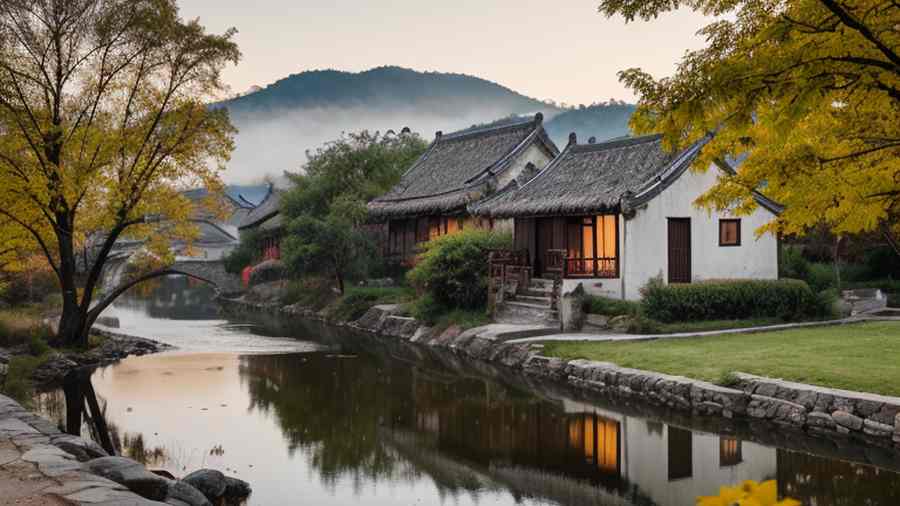
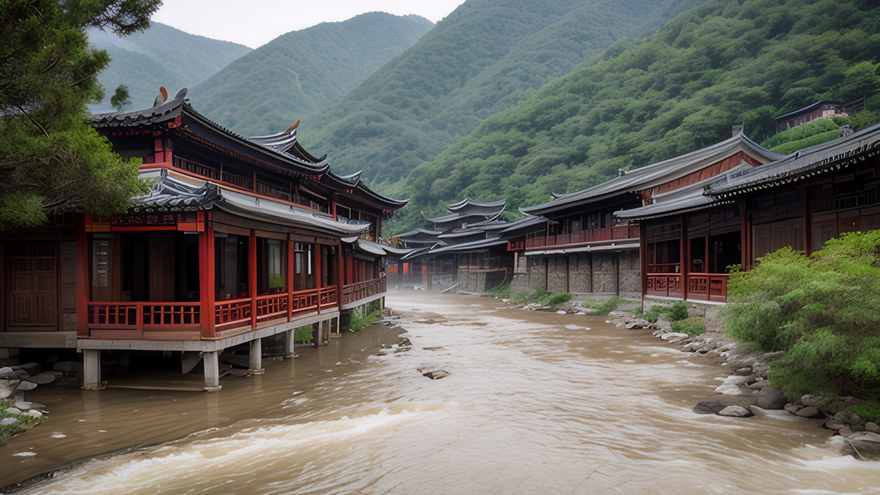
Huilongchang old street runs diagonally down the valley for over four hundred metres, its flagstones polished by wheels and feet, lined with timber shopfronts from the Qing into the republican years, red lanterns hung to one pattern and doorways sealed by sliding plank panels. The street sat on an old trade road linking Sichuan, Shaanxi and Gansu, where medicinal herbs, hides and salt changed transport, so the buildings are neither purely western Sichuan nor Guanzhong: eaves are lower and thresholds higher. Elderly residents still live here, sweeping and opening from six, leaving a rare empty hour before visitors arrive. Traffic runs one way and cars stay out; park in the public lot at the street head.
The Wei Family Compound
A flight of stone steps in the middle of the street climbs to the compound of Wei Futang, a local armed leader of the republican years: four courtyards stacked along the hill, rammed-earth walls of southern Shaanxi combined with imported glass and ironwork. The layout survives well, with main hall, side wings, a shooting tower and a rear garden, and the exhibits explain how he taxed the trade road, built paths and funded schools, adding a borderland-governance layer you rarely get in an ordinary house. There are many steps and high thresholds, so watch your feet. Allow forty minutes; guided sessions run once in the morning and once in the afternoon. Park at the street head and walk ten minutes up.
- Where to eat
- Root-flour dumplings and walnut bread in Ningqiang at lunch, a claypot chicken hotpot on the old street at night.
- Roads and driving
- National road west along a Jialing tributary: constant bends and steep grades, with dark ice possible at tunnel mouths.
- Where to stay
- A timber inn inside Qingmuchuan old street, quiet at night, shops at the door by morning.
Tips for the day
- Fill up at Ningqiang; stations are sparse beyond it
- Do not stop to photograph under scree slopes
- Most inns sit inside the street, so leave big luggage in the car
Down the river to Hanzhong, lake light and old terraces
About 210 km today
Han Reservoir and Tianhan Terrace
The Han reservoir is impounded river water inside the city, ringed with continuous walks and viewing platforms, and the Tianhan terrace stands on high ground to the north, a low imitation-antique tower from which the water and the western ridge read together. This is where Hanzhong people stroll after work: lamps are complete, paving is flat, wheelchairs and prams roll through, and it is ten minutes on foot from shore to tower steps. Park in the east-side underground garage or the marked bays, though space is scarce at rush hour, so walking in from a hotel is often easier. Arrive half an hour before sunset; the south-bank platform is the better stand, and the water throws hard light back, so place people sideways for portraits. There is no ticket, and sections close briefly during large public events, so check the notices.
Han River and Xingyuan Lake
The Han River slows across the southern edge of the Hanzhong basin, with a continuous riverside walk and viewing decks running east from Wangjiang Tower to sand bars, reeds and the low hills opposite. Evenings belong to local walkers, stalls cluster near the steps down to the water, and it blows hard: lovely for sunset in summer, damp and cold in winter. Park in the marked bays along Binhe Road and walk ten minutes; lamps cover the whole route. Walk two blocks west for fewer people. A good city stroll to balance the pace after a long driving day.
- Where to eat
- Vinegar noodles in Xixiang at noon, river fish and vegetable tofu back in Hanzhong.
- Roads and driving
- Provincial road down the river valley then onto the expressway; good views but many village mouths where e-bikes appear.
- Where to stay
- Two nights in Hanzhong city, so the luggage stays put.
Tips for the day
- Evening wind off the reservoir is real, so carry a jacket
- Cliff boardwalks turn slick in rain, wear grippy shoes
- The bridge back to town jams after six
A slow day around Hanzhong
About 80 km today
Ancient Han Terrace and Hanzhong Museum
The Ancient Han Terrace in the city is said to be the garden of Liu Bang when he held the title King of Han, and today forms the main court of the Hanzhong Museum. Its stone collection matters most: moved cliff inscriptions from Han and Wei, and among them the thirteen pieces tied to the Shimen plank road show clerical script settling into its mature form. One axis with two halls, an hour at most; audio guides are issued at the gate. Old trees, stone paving that turns slick in rain. Public bays outside are few, so arrive at opening; the lanes link on foot to Yinmachí and the General-Appointment Platform within fifteen minutes.
Liucheng and South Sand River
Ten kilometres south, Liucheng is nursery fields and paddy across the Hanzhong plain, with rapeseed and pale blossom in spring and the South Sand River running through the village over gravel bars under old bridges. You can stop along the industry road, but only at village-head concrete or marked bays; driving onto bunds will bury a wheel. There is no ticketed site here, just basin farmland and village rhythm worth walking for a kilometre or two. It gets dusty when the wind rises, so a hat helps, and the only supplies are a small village shop, so carry water from town.
- Where to eat
- Hot noodle sheets and vegetable tofu at breakfast, a farmhouse table by the flower fields at noon, hotpot in the evening.
- Roads and driving
- Two-lane industry roads along the foothills, plenty of meeting points, so drive slowly and use the pull-offs.
- Where to stay
- The same Hanzhong hotel again, nothing to move.
Tips for the day
- Rapeseed weekends are crowded; go midweek if you can
- The foothill road has no hard shoulder, so use hazards if you stop
- Get back on the expressway before dark
Back over the Qinling to Xi'an
About 300 km today
The Qinling Tunnel Group
Between Hanzhong and Xi'an the Jingkun expressway bores straight through the Qinling spine: within a few dozen kilometres tunnels alternate with high viaducts, the longest group running near nine kilometres inside, with steady lighting but speed limits stepping between eighty and one hundred and distance markers laid out. Light changes hard at the portals, and mist often pools there day or night, so switch to low beam early and take sunglasses off. Lane changes and stopping are forbidden inside; breakdowns must reach the emergency bay and the SOS phone. This is the most tiring stretch of the trip, so twenty minutes at a service area beats pushing on.
- Where to eat
- One last plate of noodle sheets in Hanzhong, then a short service-area lunch north of the ridge.
- Roads and driving
- Northbound the Jingkun climbs long and runs tunnel after tunnel with slow trucks; pass only in the open sections.
- Where to stay
- Back in the city the same day, so clear the car before the return counter.
Tips for the day
- Never coast in neutral on the long climb
- Do not change lanes inside tunnels, leave braking room on exit
- Evening traffic bunches at the Qujiang approach
Pages that help on this route
- Rental packages and what is included
- Temporary driving permit in China
- All routes by province
- All cars in the fleet
Costs to expect
Included: vehicle use, basic insurance, pick-up and drop-off. Not included: tickets, meals, hotels, fuel and tolls. Tunnels and expressway are charged by vehicle class; the old street at Qingmuchuan is free to enter, with a combined hall ticket sold separately.
Driving tips
- The Qinling runs tunnel after tunnel: take sunglasses off and switch to low beam before entering
- Roads into Qingmuchuan bend hard and shed rock after rain, so leave early and avoid night driving
- Park in Hanzhong near Dianshitai lane or Yinmachí, emptiest before ten
- Confirm cross-city return and insurance terms before you leave, not at a county counter