Route overview
A rental car for foreigners in China loop from Yichun's Mingyue Mountain airport: three days soaking in Wentang, climbing Mingyue Mountain for the Cloud Valley falls and visiting the Yangshan Zen temple, about 280 km on good expressway and park roads. It suits travellers who want to slow down, those bringing older parents, or anyone after a warm winter break; the spring town sits at the foot of the mountain, minutes from your hotel. A rental car for foreigners in China collected at Yichun needs no detour, and the low mountain speed limits make for relaxed driving.
Highlights
- The selenium springs at Wentang's old well, piped straight into most town hotels
- Cloud Valley falls on Mingyue Mountain, water dropping more than a hundred metres
- Yangshan Qiyin temple, cradle of the Weiyang school of Zen, its gate very still
- Smooth park roads, so a rental car for foreigners in China handles the climb easily
Suggested itinerary
- Day 1Day 1 Yichun pick-up, Wentang town, foot soak at the old well, about 40 km
- Day 2Day 2 Wentang to Mingyue Mountain, Cloud Valley falls, back to Wentang, about 40 km
- Day 3Day 3 Yangshan temple and Nanre village, back to Yichun, about 90 km
Day by day
Day 1 Yichun pick-up, settle into Wentang
About 40 km, expressway and provincial road
Wentang Old Well
Wentang sits in a hollow eighteen kilometres southwest of Yichun, and at its centre is an old well holding water around 68 degrees, high in selenium, which locals simply call the hot spring well. A stone balustrade rings it and the water is pumped into a public basin where elderly residents bring small buckets to soak their feet from morning to night; in winter the whole street disappears into steam. Look at the well, the washing basin beside it, the men and women drawing water, and the little street selling eggs boiled in spring water, cooked in a quarter of an hour. Come at dusk when it is busiest, soak your feet, then walk the street; half an hour covers the town. Park at the entrance car park, the main street is restricted, and most hotels have their own spaces. Ground is wet, so sandals with grip and a hand on the rail.
Wentang Spa Quarter
Wentang's spa quarter spreads along a stream valley, dozens of hotels and pools linked together, some public, some private to the hotel, all fed from underground without reheating. Most buildings went up in the last decade, white walls and grey tiles with timber screens, and at night the stream bank becomes a ribbon of light. Look for the open-air pools by the water and the old tofu workshop, where spring water is used as the coagulant and the curd is finer than ordinary. Enter a pool around three or four, soak an hour, rest, then soak again, and eat by the stream in the evening. Use the hotel's own car park; the quarter is narrow and roadside stopping blocks traffic. Wet tiles everywhere, so grip sandals and a hand on the rail for older bathers. At the far end of the quarter a small spring museum explains how the water forms and how it is drawn, free to enter and worth ten minutes.
- Where to eat
- In Wentang, eat spring-water tofu with soy sauce, then fried rice with selenium-rich Yichun rice, and stir-fried cured pork with bamboo shoots.
- Roads and driving
- From Mingyue Mountain airport take the Yi-Wan expressway to the Wentang exit, ten minutes into town. The main street is restricted by day; follow the hotel signs.
- Where to stay
- Stay in a Wentang hotel with its own spring, so you can soak and go straight to bed; for quiet, resorts in the valley outside town.
Tips for the day
- The old well foot soak is free; mornings are busy, dusk is calmer
- Buy spring-water eggs freshly boiled; cold ones turn rubbery
- Parking in town is tight, ask the hotel about spaces
Day 2 Mingyue Mountain and Cloud Valley Falls
About 40 km, park road
Cloud Valley Waterfall
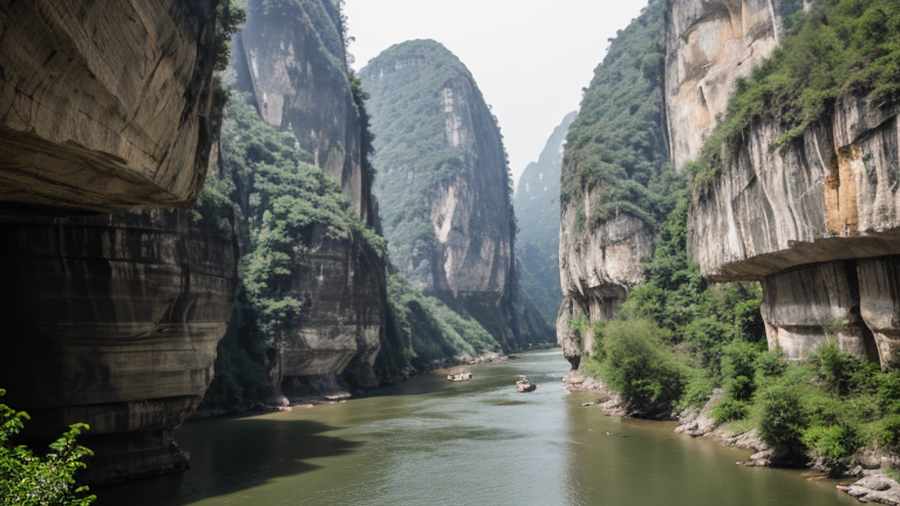
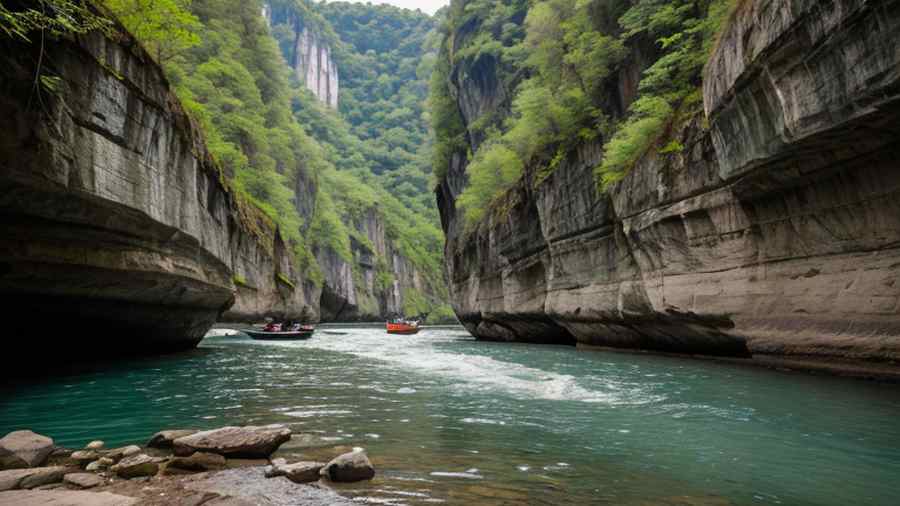
Cloud Valley falls drops from a cliff more than a hundred metres high in the middle section of the Mingyue Mountain park, split into two tiers by the rock, landing in a deep pool with mist that never clears, so your clothes dampen quickly on the viewing platform. The water comes from Moon Lake on the summit, thunderous in the wet season and a thread in dry months, leaving a dark stain down the face. Look at the fall itself, the boulders at the pool and the angle from the platform; on sunny mornings the backlight puts a rainbow in the spray. Walk down from the upper cableway station to the platform in about twenty-five minutes, continue to the Stars and Moon cave, then take the cableway down, two hours in all. Park at the lower visitor centre. Steps are wet and the spray constant, so bring a waterproof shell and protect the camera.
Moon Lake and Stars-Moon Cave
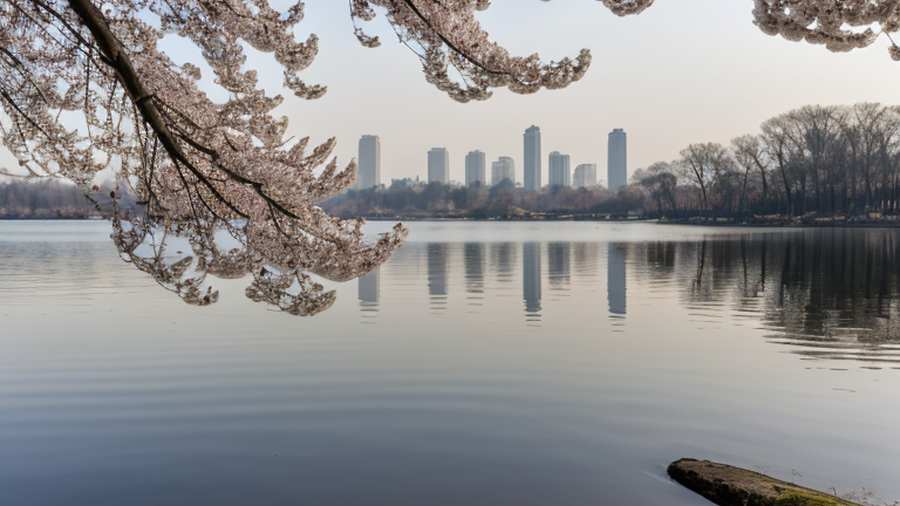
Moon Lake sits near the summit of Mingyue Mountain, a dammed alpine lake, small but still, ringed by pine and grass slopes, with autumn leaves mirrored on the surface. A lakeside path circles it in twenty minutes past a few viewpoints that open onto the Yuanzhou plain far below. Below the lake, the Stars-Moon cave is a short natural cavern lit warmly, stalagmites and stone curtains glowing amber, cold air at the mouth. Look at the reflections, the pines along the path and the formations inside. From the upper cableway station go first to the lake, then follow the path down to the cave, exit the far end and rejoin the cableway. Cars stay at the bottom; nothing drives up here. Windy by the water, so a windproof layer, and damp cave floors need grip.
- Where to eat
- Lunch at the lower visitor centre: rice steamed in bamboo with cured meat, and mountain bamboo shoots with bacon. Back in Wentang, spring-water fish, raised in the warm water and firm fleshed.
- Roads and driving
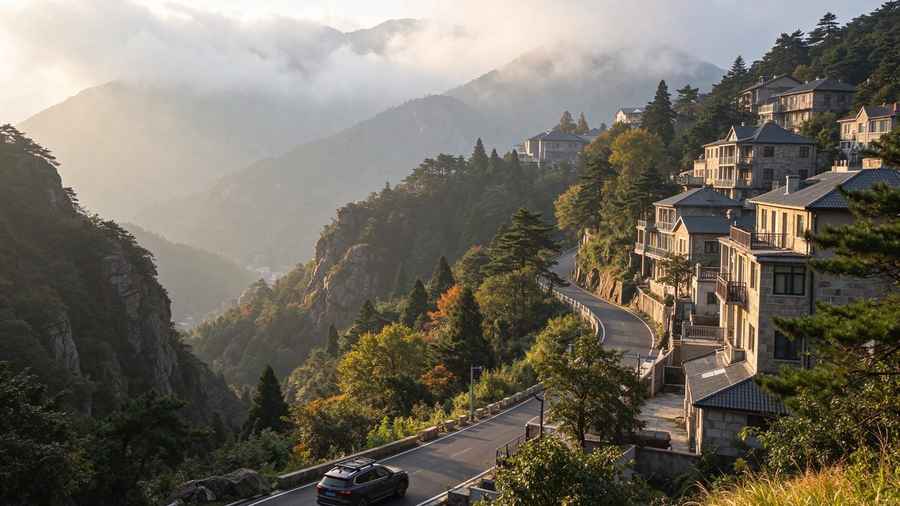
- About fifteen kilometres from Wentang to the park, a bendy but gentle road limited to 30 km/h with viewpoints along the way. This is the road a rental car for foreigners in China drives most often around Yichun.
- Where to stay
- Return to Wentang to sleep after a soak; there is no lodging on the summit and night driving down is unwise.
Tips for the day
- Cableway and park tickets are separate; the combo saves money
- Spray by the falls means a lens cloth in your pocket
- The summit runs five degrees cooler, so add a layer
Day 3 Yangshan Zen Temple, back to Yichun
About 90 km, provincial and township roads
Yangshan Qiyin Zen Temple
Yangshan Qiyin temple sits halfway up Yangshan south of Yichun and is the cradle of the Weiyang school of Zen, founded by Master Huiji in the Tang; at its Song peak it held a thousand monks, and the halls you see were rebuilt within the last twenty years. The compound climbs the slope, gate low, main hall halfway up, stone steps between old pines and tea terraces, for Yangshan tea was already tribute in the Tang. Look at the gate plaque, the old ginkgo behind the halls and the tea terraces; in autumn the whole hillside turns gold. Arrive in the morning, climb to the main hall, then walk round to the ginkgo, ninety minutes at an easy pace. Park in front of the temple, free; the last stretch of road is narrow, so find a wide spot to pass. Many steep steps, quiet inside the halls, and do not photograph the monks.
Nanre Old Village
Nanre sits at the foot of Yangshan, a hamlet of a few dozen households strung along a slope with a stream through the middle and two huge old camphors at the entrance, said to be over a thousand years old and several arm-spans around. Poor access has kept it much as it was: timber houses, farm tools under the eaves, tea seed drying in the yards. Look at the camphors, the small stone bridge and the houses stepping up the hill; in autumn the seeds are pressed for oil. Park on the open ground at the entrance and walk the stream to the far end, twenty minutes, resting under the trees. The lane is narrow and steep, muddy in rain, so drive slowly and never stop on the descent. Slabs and dirt mixed, trainers, and watch the moss by the water. Most households grow tea, and someone will usually offer you a cup of the new season; accept it, and thank them when you finish.
- Where to eat
- Lunch in Nanre: wood-fire rice and free-range chicken fried in local camellia oil. Back in Yichun, try za fen, rice noodles pressed into bundles and best stir-fried with cured pork.
- Roads and driving
- About thirty kilometres of provincial road from Wentang to Yangshan, then a narrow township lane with sharp bends, the last two kilometres single track. This is where a rental car for foreigners in China needs the most care on this loop.
- Where to stay
- No overnight if the car goes back today; otherwise a hotel in Yichun city for the Yuanzhou old quarter next morning.
Tips for the day
- Morning chanting at the temple, ask the guest hall first
- Slow down early when passing on the lane; the uphill side yields
- No shops in the village, bring water and snacks
Pages that help on this route
- Rental packages and what is included
- Temporary driving permit in China
- All routes by province
- All cars in the fleet
Costs to expect
Included: the vehicle, basic insurance, paperwork help, a trilingual road book and parking notes for the spring hotels. Not included: park tickets and cableway, spa entry, meals and hotels, fuel and tolls. Charges for a rental car for foreigners in China are per day and itemised at handover. If a rental car for foreigners in China stays two nights at a spring hotel, it can sit in the hotel garage overnight instead of moving daily.
Driving tips
- Never soak on an empty stomach; wait an hour after eating
- The cableway queues at weekends, so go midweek if you can
- Mountain evenings are cool, so put on a jacket after soaking