Route overview
A rental car for foreigners makes this straightforward: From Taiyuan climb north to Wutaishan for the temples on the ridge, then west across the plateau to Datong and the Yungang caves, coming back south on the expressway. Long climbs on the first day, high passes that stay cold, and a lot of trucks on the return.
Highlights
- Pusa summit
- Dailuo peak
- Xiantong temple
- Shanhua temple
- Nine dragon screen
- Yungang grottoes
- Huayan temple
Suggested itinerary
- Day 1D1 Taiyuan to Wutaishan, about 230 km (Pusa summit, Dailuo peak, Xiantong temple)
- Day 2D2 Wutaishan to Datong Yungang, about 200 km (Shanhua temple, nine dragon screen, Yungang)
- Day 3D3 Yungang back to Taiyuan, about 280 km (Huayan temple)
Day by day
Day 1 Taiyuan to Wutaishan
About 230 km, the last 40 km climbing
Pusa summit
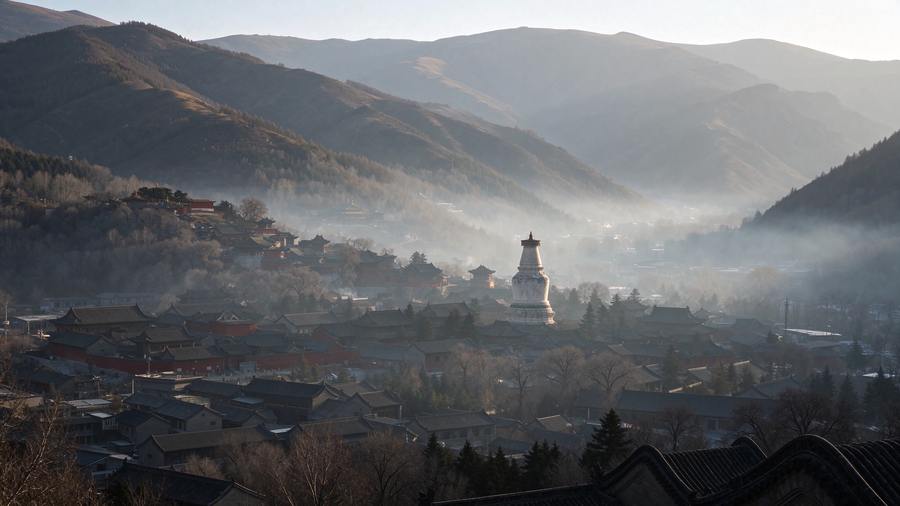
Pusa Ding sits at the highest point of Taihuai town, the largest yellow-hat temple on Wutaishan, visited by Qing emperors, its halls carrying a courtly weight and glazed tiles that catch the light. A hundred and eight steps climb from the road, wide, with a carved dragon in the middle, ten minutes at an easy pace. From the front hall the whole town lies below: white stupa, temple roofs, the river valley. A separate ticket from the town gate ticket, hats off inside, no photography.
Dailuo peak
Dailuo Ding on the hillside holds the five Manjusri figures; local belief says one climb here stands for visiting all five peaks, which is why the crowd is thickest. Three ways up: 1,080 steps, a cable car, or the old horse track. The steps are narrow and steep, give way when it is busy, and take the cable car if your knees object. The platform on top opens wider than Pusa Ding. Before eight is quiet; by noon it is all tour groups. Windy and cool at the top.
Xiantong temple
Xiantong is the oldest foundation on Wutaishan, first built in the Eastern Han, roughly the age of Baima temple in Luoyang, and called the mountain mother temple. Halls run along the axis: the bronze hall of the Ming, cast whole and small but finely worked; the beamless hall of brick vaults; the thousand-bowl Manjusri hall. Incense is heavy, and the morning chant is the hour with most atmosphere. Entry comes with the town ticket, security check at the gate, leave the big incense bundles behind.
- Where to eat
- One street in Taihuai is all vegetarian kitchens: luohan zhai and mushroom stewed with tofu, forty to fifty a head; noodle shops charge a dozen for a bowl. Mountain prices run high, buy water and snacks in Taiyuan.
- Roads and driving
- In a rental car for foreigners, erguang expressway to Xinzhou, then the Wutaishan road; the last forty kilometres climb hard with buses, so overtake only with clear sight. Parking is tight in season, expect a shuttle. Fog comes up in the evening, do not drive it at night.
- Where to stay
- Taihuai town, guesthouses 200 to 400; quieter and half the price down at Shizui or Jingangku, coming up next morning.
Tips for the day
- Town ticket and temple tickets are separate
- Temperature swings ten degrees or more
- Soft shoes for the steps
Day 2 Wutaishan to Datong and Yungang
About 200 km over the Yanmen pass road
Shanhua temple
Shanhua stands south of the old city, a Liao and Jin monastery with gate, three sages hall and main hall in one line, timber frames original and never heavily rebuilt, which is why architectural historians rate it. The main hall brackets are huge, five Buddhas inside with full Liao faces. Few visitors, so you can look properly; an hour covers it. Cheap ticket, park outside the walls and walk five minutes.
Nine dragon screen
The nine dragon screen is what remains of the front wall of the Ming princely palace, earlier and larger than the one in Beijing. Five colour glazed tiles make nine dragons, one frontal in the middle and four each side, over a sea and cliff base. What you come for is the glaze and the movement of the bodies, best in sun. Small, twenty minutes, beside the palace ruins walk. A few yuan, park outside the block.
Yungang grottoes
Yungang sits in the south cliff of Wuzhou mountain west of Datong, cut under the Northern Wei, running a kilometre with 45 main caves and more than 59,000 figures. Caves 16 to 20 are the earliest, the Tan Yao five, and the open Buddha of cave 20, over ten metres, broad-faced, is the image everyone knows. Caves 5 and 6 carry the densest relief, flying apsaras and donors in layers, bring a torch. No flash, no touching. The gate is a twenty minute walk from the caves, electric carts extra, and the sun is fierce in summer.
- Where to eat
- Datong: knife-cut noodles, lamb offal soup, and the shumai at Fenglin ge in the old city; food at the grotto gate is expensive, eat in town. Hunyuan cold jelly makes a good road stop.
- Roads and driving
- In a rental car for foreigners, leave Wutaishan towards Shahe for the expressway, over the Yanmen pass line to Datong: mountain curves, tunnels, snow in winter. Datong streets are wide but the old city is strictly limited, watch the signs. The grotto car park is large and queues in season.
- Where to stay
- Old city guesthouses 200 to 350, an evening on the wall; or stay near the grottoes to skip the morning drive.
Tips for the day
- Take the audio guide at Yungang, the carvings need explaining
- No flash inside the caves
- The Yanmen stretch ices over; use the national road in bad weather
Day 3 Datong back to Taiyuan
About 280 km, all expressway
Huayan temple
Huayan stands inside the west gate of the old city, built under the Liao, split into upper and lower. The upper main hall is one of the largest Liao and Jin halls, nine bays across, and the scale lands when you stand in front. The lower Bhaga library hall keeps a ring of Liao painted clay figures, the bodhisattvas full of life, the one called the oriental Venus among them. Behind is a reconstructed timber sutra library. Allow time for the clay figures, the light is dim and your eyes need a minute.
- Where to eat
- A bowl of noodles at a service area on the way, or taoyuan and yellow wine in Taiyuan, a local breakfast outsiders rarely take to.
- Roads and driving
- Erguang expressway south, 280 km, good surface but heavy coal traffic, keep your distance and stay out of the fast lane. City-bound traffic builds after three.
- Where to stay
- Back to Taiyuan today. One more night in Datong puts Xuankong temple and Hengshan on tomorrow.
Tips for the day
- Stop once on the long run
- There is a long descent, use the gears
- Old city combined tickets are dated, buy them in the morning
Costs to expect
Fuel, tolls, parking and temple or cave tickets are paid on the spot; the rental car is booked separately and no package price is quoted.
Driving tips
- Wutaishan sits above 1,700 metres, take a jacket even in July
- Temple tickets are bought at the gate, cash and card both work
- The return expressway has heavy truck traffic, keep the right lane