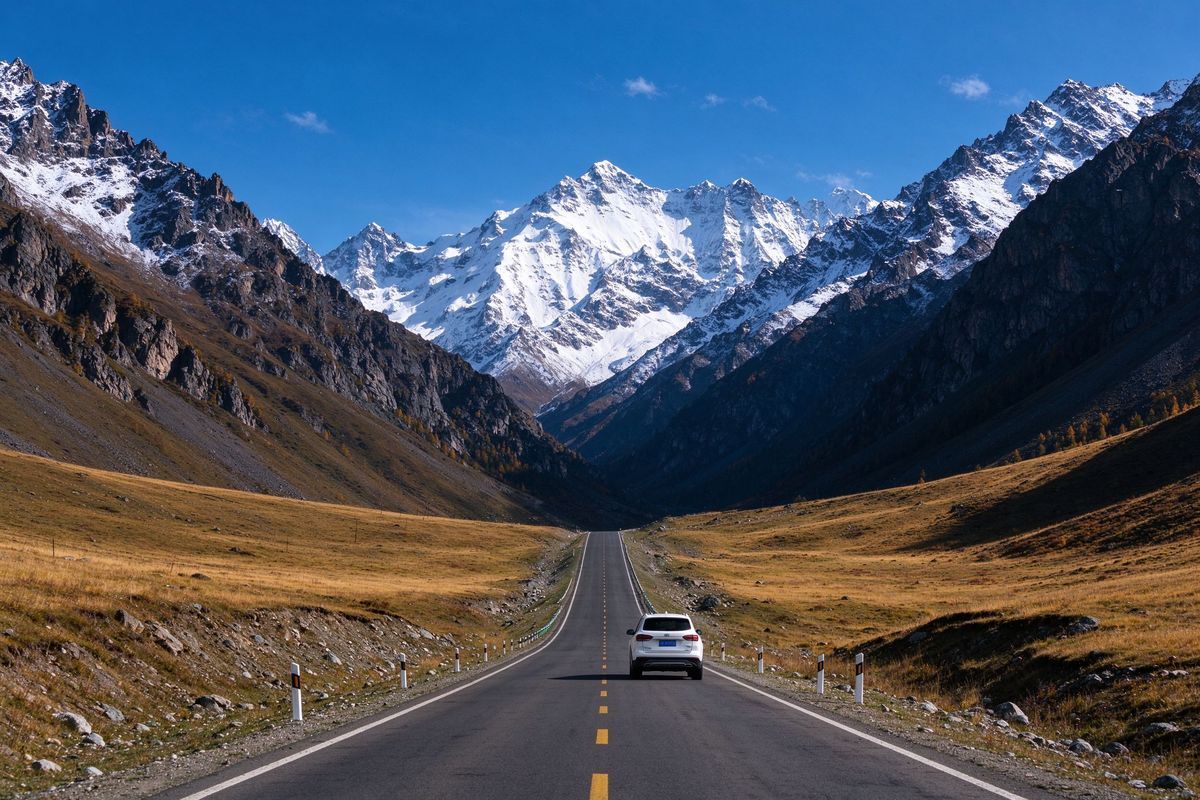
Can Foreigners Drive the Duku Highway? 2026 Complete Guide
I drove the Duku Highway (G217, Dushanzi to Kuqa) for the first time in 2014. Since then I have taken it almost every summer, with Chinese and foreign guests alike. It is 561 km of road that crosses the Tianshan mountains, switching from northern grasslands to southern desert in a single day. It is also one of the few places in China where foreigners are welcome without special permits, as long as you have a valid Chinese temporary driving permit. This is my complete guide.
What is the Duku Highway?
The Duku Highway connects Dushanzi (near Karamay, northern Xinjiang) to Kuqa (in the Tarim Basin, southern Xinjiang). It was built in the 1970s as a military supply road and opened to civilian traffic later. It crosses four high mountain passes, three of which sit above 3000 meters. Along the way you see alpine meadows, snow-capped peaks, conifer forests, desert canyons, and river valleys. Chinese drivers call it a road that sees four seasons in one day.
When is it open?
Only between roughly early June and early October. The exact opening and closing dates depend on snow conditions and are announced by Xinjiang traffic police each year. In 2026, expect it to open around June 5 and close around October 10. Outside those dates the road is closed — snow blocks the passes and no one clears it in winter.
My advice: go in the second half of September. The grasslands turn golden, the weather is stable, and the crowds are much thinner than in July and August. July and August are peak season: Nalati meadow hotels can triple in price and you will queue at the scenic area gates.
Can foreigners actually drive it?
Yes. Unlike Tibet or certain border zones in Xinjiang, the Duku Highway itself does not require a special permit for foreign tourists. You just need:
- A valid passport with Chinese visa or visa-free entry.
- A valid Chinese temporary driving permit (we arrange this for you, 1500 RMB).
- A rental car or your own vehicle that has been properly declared at the border.
There are police checkpoints along the road. They will ask to see your passport and your temporary driving permit. Just show them, answer their questions, and drive on. I have never heard of a foreign tourist being turned around on the Duku Highway as long as their papers are in order.
One restriction: vehicles with more than 7 seats are banned. The road is narrow and winding, and larger buses are not allowed. Any normal sedan or SUV is fine — we rent Volkswagen Lavida (260 RMB/day) and Tank 300 SUV (400 RMB/day) for this route.
The route day by day
Most people take 3 days to drive the Duku Highway. You can do it in 2, but you will miss too much.
Day 1: Dushanzi to Nalati (about 250 km, 6-7 hours). Start early from Dushanzi. You climb into the Tianshan, pass through the Wuyi tunnel, and reach the first alpine meadows. Stop at the Yilihe viewpoint. Stay overnight in Nalati town. The town is small but has plenty of hotels and restaurants.
Day 2: Nalati to Bayanbulak (about 80 km, 2 hours). Morning in Nalati: take the scenic area shuttle onto the Nalati Sky Grassland. In the afternoon drive the short stretch to Bayanbulak. Stay overnight in Bayanbulak town. Get up before sunset to see the Nine Bends and Eighteen Curves of the Kaidu River — this is the most photographed spot on the whole route.
Day 3: Bayanbulak to Kuqa (about 230 km, 5-6 hours). You cross the Tielimai pass (around 3200 m), descend through the Tianshan, and reach the red sandstone canyons near Kuqa. Stop at the Tianshan Mysterious Grand Canyon. End the day in Kuqa Old Town, where you can eat lamb skewers and rest under the grape arbors.
Fuel, food and lodging
Fuel: PetroChina stations in Dushanzi, Nalati town and Kuqa. Between Nalati and Bayanbulak there are no gas stations — fill up in Nalati before you leave. The whole 561 km will use about 60-70 liters in a sedan.
Food: Nalati and Bayanbulak both have Uyghur and Han restaurants. Mutton skewers (5 RMB each), naan bread (3 RMB), noodle dishes (20-30 RMB). Between towns there is almost nothing, so pack snacks and water in the car.
Lodging: Book Nalati and Bayanbulak hotels in advance in July-August. Off-peak (September) you can walk in and get a room. Budget 200-400 RMB per night for a decent hotel.
Road conditions and driving tips
The whole road is paved. Sedans can do it without difficulty. But:
- It is winding, with many hairpin turns. Do not overtake on bends.
- Altitude on the passes reaches 3200-3400 m. If you feel altitude headache, drink water, walk slowly, and do not sleep at high altitude overnight.
- Weather changes fast at the passes. Even in July it can drop to near zero at night. Bring a warm jacket.
- Do not drive at night. The road has no streetlights and animals (sheep, horses, camels) wander onto it.
- Speed cameras are posted. Follow the speed limits.
Can I bring my own car across the border?
Yes, we do this. If you drive your own car from Khorgas (Kazakh border) or Mohan (Lao border), we handle the customs declaration, temporary license plates (valid 3 months), temporary driving permit, and insurance. Service fee from Khorgas is 6000-9000 RMB, from Mohan 5000-6000 RMB. Customs deposit is 10000 RMB (we guarantee the rest, normally it would be 50-65% of the car value), refunded 3-5 working days after you leave China. Right-hand-drive cars are accepted at all ports with no extra fee — just remember China drives on the right, so give yourself a day to adapt.
What we provide
We rent cars at Kunming and Lijiang airports. If you want to do the Duku Highway, I suggest you fly to Urumqi and rent there — we can also arrange that. We also handle your Chinese temporary driving permit (1500 RMB, you do not need to appear). We recommend reliable hotels along the route and can send you a detailed route plan.
WeChat qxzj7557 (WhatsApp: +86 13759155671), email [email protected]. Tell us your dates and group size and we will put together a plan.
If you want to rent a car in Urumqi and drive the Duku Highway, see Duku Highway Rental Car Guide.