Dali Lijiang car rental for foreigners: picking your pace around Erhai
I pulled over last April on the west shore of Erhai, windows cranked all the way down, jasmine scent from a roadside hedge curling into the cabin of the 1.5L VW Lavida I’d picked up that morning. My mate, who’d been rambling about temple visits for 45 minutes, suddenly went quiet. We were staring out at the lake, the surface streaked pale silver where the midday sun hit it, and a group of local elders were flying kites from a patch of grass right by the water’s edge. That’s when it hit me: I’d made a mistake the first time I drove Erhai, three years prior, by sticking rigidly to the east shore route I’d seen on a generic travel blog. It’s not a case of one side being better. It’s a case of what pace you actually want for your Yunnan trip. Yunnan self-drive rental for foreigners has one bottleneck, and this is it.
Pre-trip rental basics no one tells you upfront
Let’s get the admin out of the way first, because I’ve seen too many overseas travellers turn up to Yunnan expecting to jump in a car same day without pre-planning. Dali Lijiang car rental for foreigners is straightforward once you know the rules, no hoops you can’t clear well before you land. A China temporary driving licence can be arranged for 1500 without you needing to attend in person, which takes a lot of the stress out of pre-trip prep. The vehicles are all petrol, no EVs to catch you out on remote mountain stretches with no charging points. The VW Lavida 1.5L or Jetta 1.4T comes in at 260 per day, with a 3000 rental deposit and unlimited mileage, perfect for most groups of two or three travelling light. If you’re heading up to higher, rougher roads beyond Erhai, the Tank 300 2.0T is 400 per day, 5000 rental deposit, with a 300km per day limit to keep running costs predictable. That is the side of Kunming airport car rental for foreigners the brochures leave out.
I picked up my most recent rental straight from the airport, no faffing with city bus connections after a four-hour flight from Chengdu. Kunming airport car rental for foreigners works exactly the same as picking up from a Dali or Lijiang city office, just make sure you do the full walkaround check before you turn the key in the ignition. The insurance includes compulsory and commercial cover, just a couple of small fine print points to note: minor scratches under 1500 are paid by you, damage above 1500 goes through insurance with you bearing 30%, and scratches that don’t damage the primer are completely free. No downtime or depreciation charges for paintwork or replaced parts, and downtime is waived within 5 days for major damage, which is a far better deal than most international rental firms offer. The rental deposit is refunded 5-7 working days after you return the car, once the traffic fine check is complete, and the 600 booking deposit is non-refundable if you cancel for personal reasons. One small thing I learned the hard way: if you drop the car off in a different city to where you picked it up, say Lijiang instead of Dali, the one-way return fee is 1500, so factor that into your budget if you’re not doing a loop. Everyone I know who has dealt with Yunnan self-drive rental for foreigners tripped on this.
You don’t have to do the whole Kunming to Dali to Lijiang drive in one go, by the way. A lot of people fly straight into Dali these days, but if you want to break up the journey and stop off at the stone forest outside Kunming for a day, Yunnan self-drive rental for foreigners lets you set your own itinerary without being tied to bus timetables.
Erhai’s west shore: slow, meandering, stop whenever you want
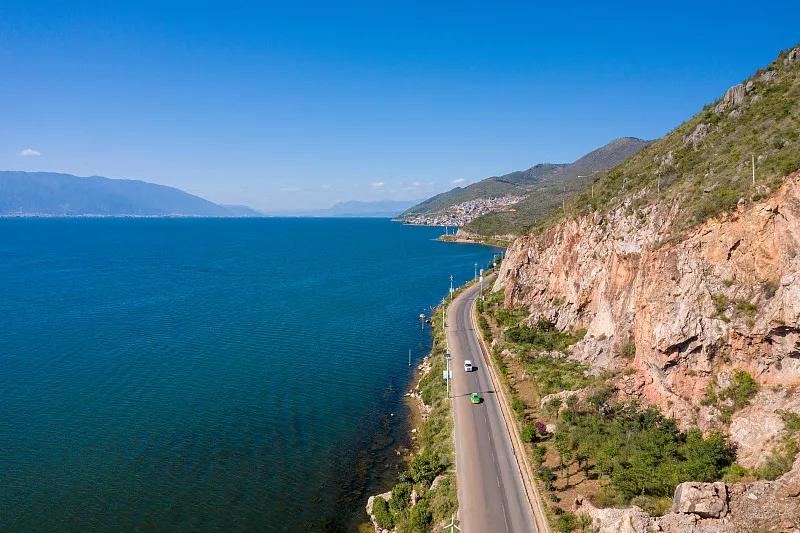
Back to that April drive on the west shore. The road here is narrow in places, lined with old farmhouses, small family-run tea shops, and stretches of wetland where egrets stand stock still in the shallow water. You can’t go fast even if you want to. There are cyclists wobbling along the hard shoulder, old women carrying wicker baskets of vegetables crossing the road without looking, and hidden little turn-offs that lead straight down to quiet lake beaches that don’t appear on any tourist maps.
We spent three hours that afternoon driving less than 20km. We stopped for cold rice noodles at a roadside stall run by a woman who didn’t speak a word of English, who just gestured for us to sit down and handed us two bowls slathered in chilli oil. We wandered through a pear orchard in full bloom, petals sticking to our jackets, and sat on a weathered wooden jetty watching local fishermen pull in their nets. I’d originally planned to get to Xizhou Ancient Town by 3pm, and we didn’t roll up until nearly 6. But that’s the point of this route. It’s built for people who don’t want to tick landmarks off a list. If you’re the sort of traveller who gets frustrated when you have to leave a nice spot because your bus is leaving in 10 minutes, this is the shore for you.
There are a couple of small practical things to note. Parking is mostly free at the small village stops, though the official car parks near the bigger ancient towns charge a small fee. The tarmac is smooth for almost the entire stretch, so even the smaller 1.5L Lavida handles it easily, no need for a 4WD unless you’re planning to head up into the Cangshan mountains afterwards. I don’t recommend trying to drive it all in a single morning. You’ll spend the whole time staring at the road instead of the lake. Give it a full day, minimum.
Erhai’s east shore: wide open roads, big views, faster pace
My first ever Erhai drive, three years ago, was on the east shore. I’d picked up a Jetta 1.4T from Dali station at 9am, and I thought I’d whiz around the whole lake in half a day. The road here is wide, smooth, newly resurfaced in stretches, with unbroken views across the water to the Cangshan range on the opposite shore. You can see the whole snow-dusted mountain range stretch out in front of you on clear days, the peaks reflected perfectly in the lake if there’s no wind.
This side is for people who like a bit more momentum, who want to cover more ground and hit a mix of well-known spots without rushing. There are dedicated photo stops with big car parks, the famous white statue of Erhai’s goddess, and a string of nice coastal cafes with big outdoor terraces that look straight out over the water. I did the full 70km east shore stretch in a little over two hours, stopping three times for photos, then carried on up to a small village famous for its baked cheese for lunch. If you’re on a tighter schedule, and you want to fit in a drive around the lake before heading north to Lijiang the same afternoon, this route works perfectly. You don’t get stuck behind slow-moving tractors or wandering livestock the way you do on the west shore, so you can set a steady pace without constant stopping and starting.
That said, I don’t think it’s the right pick if you only have one day around Erhai and you’re after quiet, unplanned moments. Most of the little hidden turn-offs are blocked off now, and a lot of the roadside spots are developed into designated tourist areas. You won’t stumble on a random unmarked noodle stall run by a local grandma out here. It’s still beautiful, don’t get me wrong, but it’s a different kind of experience. More suited to a group that wants to get some great photos, tick off the key Erhai viewpoints, and make good time to their next stop.
Which one is for you?
I’ve done both routes three times each now, and I still flip a coin sometimes depending on my mood. If you’ve got 10 days or more for your Yunnan trip, and you’re not in any rush to get to Lijiang, take the west shore. Spend the night in a small guesthouse in Xizhou, wake up at dawn to watch the sun come up over the lake, and drive north slowly the next day. If you’ve only got 5 or 6 days, and you want to fit Dali, Lijiang and a quick detour to a lower section of the Shangri-La road in, the east shore will let you see Erhai’s best views without eating up half your trip.
Last tip: no matter which route you pick, fill up your tank in central Dali before you set off. Petrol stations are few and far between on the more remote stretches of both shores, and I’ve seen a couple of rental cars pulled over on the hard shoulder waiting for a jerry can, which rather ruins the vibe of a nice day out. If the vehicle breaks down for a mechanical reason, it’s all covered, but towing for a client-caused reason is at your expense, so don’t run the tank low. I learned that one the hard way, on that first east shore drive, when I got distracted by the views and forgot to check the fuel gauge.
It’s not a competition. Neither shore is the right one for every traveller. You just have to be honest about what pace you actually want, before you turn the key in the ignition.