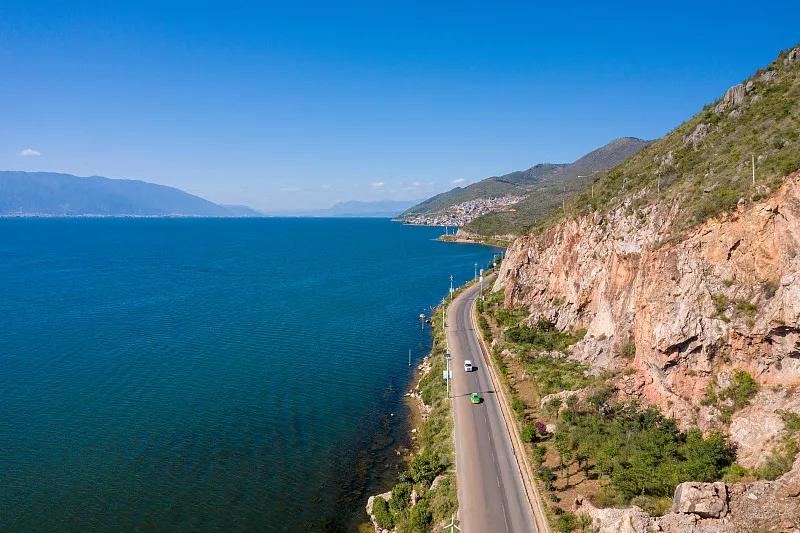
That time I crumpled a side mirror outside Xizhou, and what I learnt to stop you doing the same
Last March, the plum blossom orchards outside Xizhou were in full, frothy white bloom, the air sharp with the faint, sweet tang of pear blossom and brick kiln smoke drifting over the Erhai lake shore. I’d pulled in on a narrow lane that ran between two mud-brick village homes, aiming for a little family-run b&b; I’d found scribbled on a scrap of paper, and I misjudged the gap between my rental car and a protruding stone water tap sticking out of a courtyard wall. There was a sharp, brittle crack, and the passenger side mirror hung dangling by a single wire. I sat there for ten seconds, staring, because I’d been so careful on the main ring road around Erhai, and the village lanes had crept up on me completely unawares. Yunnan self-drive rental for foreigners has one bottleneck, and this is it.
That’s the exact scenario I see so many new visitors to Yunnan run into, and it’s the reason I put this specific guide together for anyone planning to explore Dali and Lijiang’s quieter, less tourist-trafficked spots on their own terms. That is the side of Kunming airport car rental for foreigners the brochures leave out.
Pre-trip basics no one tells you before you book
First off, you don’t need to mess around trying to sort out your own driving paperwork before you arrive. A China temporary driving licence can be arranged for 1500 without the client attending in person, which takes all the faff out of the pre-trip admin. Yunnan self-drive rental for foreigners is set up to work for people flying in from overseas, no one drives their own vehicle across any border here, and all the popular routes around Kunming, Dali, Lijiang and Shangri-La are fully accessible with a local rental.
I always recommend picking up your vehicle as close to your arrival point as possible, to avoid a tedious cross-city transfer after a long flight. Kunming airport car rental for foreigners is a straightforward option if you’re flying into the province capital first and planning to work your way west towards Dali over a couple of days, stopping off at the lesser-known tea hills and mountain villages en route. Pickup and return works at either the airport or a city office, so you can tailor that to match your itinerary without extra hassle. Everyone I know who has dealt with Yunnan self-drive rental for foreigners tripped on this.
Let’s talk vehicles, because the one you pick makes a world of difference on those narrow village lanes. The two petrol saloon options, the VW Lavida 1.5L and Jetta 1.4T, are 260 RMB per day, with a 3000 RMB rental deposit and unlimited mileage. They’re light, easy to manoeuvre, and their lower profile means you can slip through gaps that bulkier vehicles would get stuck in. That said, if you’re planning to veer off the tarmac onto any of the unpaved tracks that wind up into the hills above Shuanglang, the Tank 300 2.0T comes in at 400 RMB a day, with a 5000 RMB rental deposit and a 300 km per day limit. It sits higher off the ground, so you’re far less likely to scrape the undercarriage on sunken drainage covers or uneven stone paving that’s common in the older parts of the villages. The tricky part of Kunming airport car rental for foreigners is always the bit nobody explains.
I took the saloon on that trip to Xizhou, and while I fixed the mirror issue easily enough later, I did scrape the undercarriage once on a sunken manhole cover that was half hidden by puddle water after a light rain shower. I got lucky, no real damage done, but it made me switch to the Tank 300 for the rest of that trip, and I’ve used it for most of my rural Yunnan drives since.
Navigating Xizhou and Shuanglang’s narrow lanes: the no-damage playbook
I was walking the lanes around Xizhou’s old town a few weeks back, and I watched a visitor in a rental car spend 12 minutes reversing out of a lane that was barely wide enough for a single ox cart, his side mirror brushing a wall three separate times in the process. He looked flustered, a group of local grannies were stood on the sidelines laughing gently and offering unhelpful directions, and he was clearly one wrong move away from snapping the whole mirror clean off.
Here’s what I do now, after that cracked mirror incident of my own. First, before you turn down any lane that looks narrower than the main road, roll both your side mirrors in manually. All the rental vehicles have a little lever on the base of the mirror that lets you flip them flat against the door in two seconds. Do it before you commit, not half way through the gap, when you’re already inches from a wall. I now do it as second nature, every time I see a stone wall on both sides of the road ahead.
Second, don’t try to drive right up to the door of the guesthouse if you can see the lane ahead narrowing. Park 50 metres back, in one of the little paved laybys that sit just outside most of the old village cores, and walk the rest of the way. The lanes are full of stray cats, children chasing each other, old men pushing bicycles stacked high with fresh greens, and you will not make good time driving through them anyway. I once tried to squeeze down a lane in Shuanglang to get to a lakeside café, and ended up stuck behind a farmer herding three goats. I waited 15 minutes, and would have been faster walking from the main car park ten minutes away.
For undercarriage protection, slow down to 10 km an hour the second you leave the main tarmac road. A lot of the village lanes are paved with uneven, rough-hewn stone slabs that have been there for decades, with gaps between them that can catch the bottom of a lower saloon. If you see a sunken drainage channel running across the lane, angle one set of wheels at a time over the top, rather than driving straight over it, so you don’t bottom out in the dip. I saw a visitor last year ignore that, and ended up with a nasty dent in the bottom of their sump that took two days to fix.
Last autumn, I was heading back from a little village north of Shuanglang at golden hour, the lake glowing pink behind me, and I met a tractor coming the other way on a lane that was barely wide enough for one car. There was no space to pull in, no layby, and the only way past was to fold both mirrors in, edge onto the soft grass verge on my side, and creep past at walking pace. The driver of the tractor gave me a thumbs up as I went, and we both carried on our way without a scratch. It’s the kind of small, unplanned moment that makes these drives feel worth it, as long as you don’t panic.
What to do if you do still nick something, no stress
Dali Lijiang car rental for foreigners comes with clear, straightforward insurance rules, so you don’t have to panic if something does go wrong. The insurance includes compulsory and commercial cover, so you’re never left high and dry. Minor scratches under 1500 are paid by the client, damage above 1500 goes through insurance with the client bearing 30%, and scratches that do not damage the primer are completely free. There are no downtime or depreciation charges for paintwork or replaced parts, and downtime is waived within 5 days for major damage, so you won’t get hit with unexpected hidden bills.
The rental deposit is refunded 5-7 working days after return, once a traffic-fine check is complete, so there’s no long wait to get that money back to your account. If the vehicle breaks down for a mechanical reason, that is fully covered, but towing for a client-caused reason is at the client's expense, so it pays to drive carefully on those rough village lanes to avoid needing a tow out.
One small note on bookings: the 600 booking deposit is non-refundable if the client cancels for personal reasons, so it’s worth locking your dates in once you’re sure of your itinerary. If you want to drop the car off somewhere different to your pickup point, the one-way return fee for dropping it in Lijiang, for example, is 1500, which is useful if you want to fly out of Lijiang at the end of your trip rather than looping back to Dali.
I don’t recommend taking the saloon down any of the steeper, unpaved tracks that head up into the Cangshan foothills, by the way. I watched a friend try it a couple of years back, and they scraped the undercarriage so hard they had to reverse all the way back down to the main road. The higher ride height of the Tank 300 makes that kind of rough track trivial, and it’s well worth the extra 140 RMB a day if you plan to stray far from the main tourist routes.
Navigation works perfectly well across all of the main routes and most of the village lanes, but I always keep my speed below 20 km an hour once I’m inside any of the old village cores. You never know when a toddler is going to dart out from between two courtyard doors, or a bicycle loaded with hand-thrown pottery is going to wobble out into the road. It’s not a race. The whole point of self-driving around here is that you can stop whenever you want, for as long as you want, to watch the sun set over Erhai or buy a bag of freshly roasted walnuts from a roadside stall.
Last month I was in Xizhou, walking the same lane where I cracked my mirror that first time, and I saw a driver fold their mirrors in before they turned in, exactly the trick I now use every time. They waved, they smiled, and they slipped through the gap without so much as brushing a wall. That’s the sweet spot, right there. Slow, calm, no rush, no unnecessary damage, and all the time in the world to take in the view.