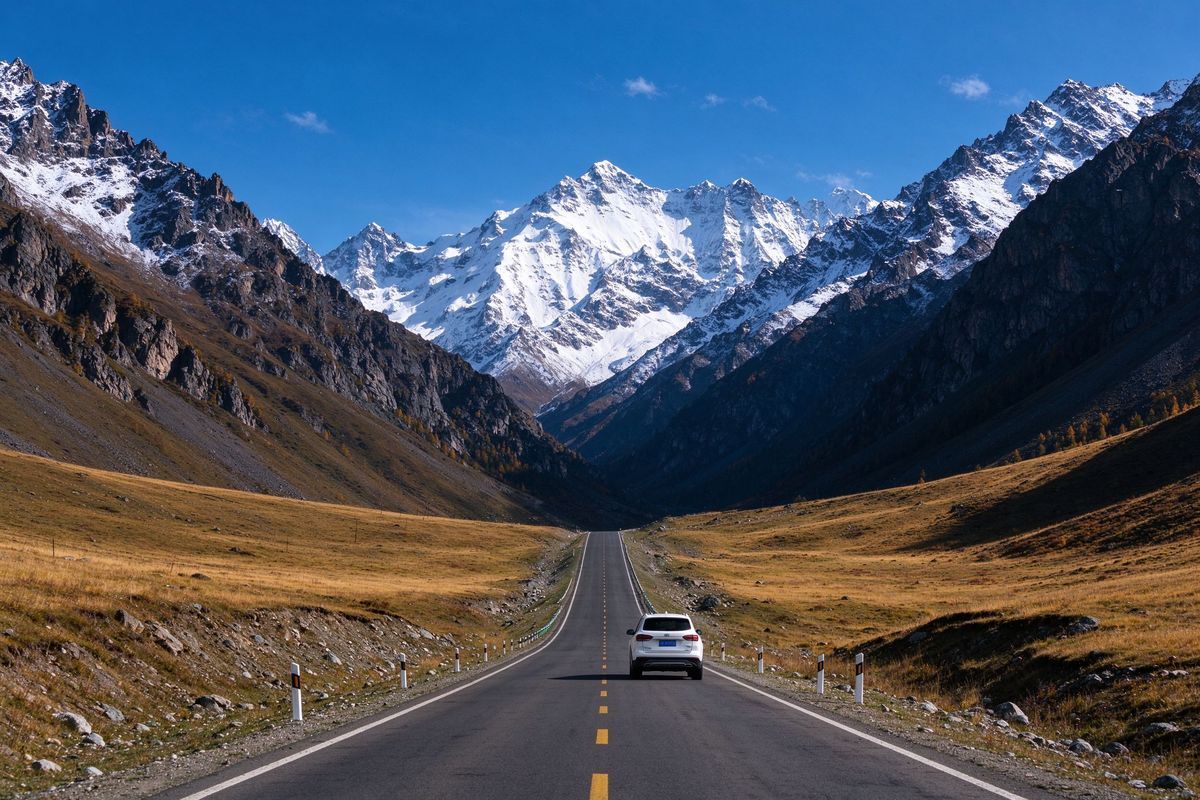
The number of people messaging me about the G219 has grown noticeably over the past couple of years, especially foreign travellers who want to drive all the way from Xinjiang to Tibet. Many are drawn in by photos of empty high-desert roads, only to find while planning the trip that not every section of this highway is open to them. Drawing on the western China trips I have run with guests, I will explain the route, the restrictions on foreign drivers, and the legal way to get from Xinjiang to Tibet, so you do not fly all the way to China only to be turned back at a checkpoint.
What the G219 actually is
The G219 runs from Kanas in northern Xinjiang down to Dongxing in Guangxi, more than ten thousand kilometres in total, hugging China's western border. The section people ask about most is the Xinjiang-Tibet stretch, often called the Xinjiang-Tibet Highway. It crosses the Kunlun and Karakoram ranges, with much of the route sitting above 4,000 metres; names such as Dahongliutan and the Jieshan Pass are familiar to anyone who has driven it.
The scenery is vast and desolate, and it is normal to go hundreds of kilometres without passing a handful of households. Precisely because it runs along the border, it is also a tightly managed border area. Who may travel it and which cars may enter are fixed rules, not decisions made on the spot.
Sections foreign drivers cannot use
Let me give you the bottom line: three sections are closed to foreign visitors.
First, the Dahongliutan section of the Xinjiang-Tibet G219 is not open to foreigners. Second, the stretch from Yecheng near Kashgar to Rutog by Pangong Lake is likewise closed. Third, the newly built no-man's-land highway toward Minfeng is also off limits to foreigners.
Checkpoints sit on all of these sections. Passports are inspected at the gate, and foreign visitors are turned back with no room for negotiation; there are no side roads to slip around them. I have seen guests try their luck and push on anyway, only to be stopped in the wilderness and sent back hundreds of kilometres, with their hotels and the rest of the itinerary in ruins. My advice is simple: do not test it. Remove these sections from your plan from the start.
The legal way from Xinjiang to Tibet: loop back to Golmud and take the G109
Being unable to use that part of the G219 does not mean you cannot reach Tibet from Xinjiang. The legal route is to loop back to Golmud in Qinghai and enter Tibet on the G109 Qinghai-Tibet Highway.
The route works like this: from Kashgar or Urumqi, head through Ruoqiang and Mangya to Golmud; rest and restock there, then join the G109 over the Kunlun Pass and Tanggula Pass, via Nagqu all the way to Lhasa.
The G109 is fully paved, and the altitude climbs gradually, which gives your body an easier time acclimatising. Petrol stations, repair shops and places to eat and sleep are more plentiful than on the G219, and it is open to foreign visitors without obstruction. It adds two or three days of driving compared with the closed shortcut, but the road is reliable and supplies are dependable, which makes for a calmer trip. If you are unsure how to arrange the Qinghai portion, take a look at this Qinghai Lake loop plan first.
Which car to choose for a local rental on this route
We do local rentals, meaning you fly into China and rent a car here; there is none of the paperwork involved in bringing your own vehicle across the border. The fleet has just two models, and I will describe them in terms of this route.
The Volkswagen Lavida 1.5L or Jetta 1.4T is 260 RMB per day with a 3,000 RMB deposit and unlimited mileage. Since the G109 is paved the whole way, a sedan handles it without trouble, and guests on a budget who do not plan to leave the tarmac are well served by it.
The Tank 300 2.0T is 400 RMB per day with a 5,000 RMB deposit and a 300-kilometre daily limit. With its high ground clearance and strong engine, it gives you confidence when you want to take a side track or an unpaved stretch in the desert, and the large boot holds long-haul luggage and supplies comfortably. Guests I take on long routes through Xinjiang and Qinghai tend to pick the Tank 300.
One more point: we do not offer electric cars. Distances between western county towns are long and charging points are sparse, so an electric car does not give peace of mind on this journey; a petrol car is the more dependable choice here.
Documents: we arrange the temporary driving permit
China is not a party to the relevant international road traffic conventions and does not recognise International Driving Permits. To drive in China, a foreigner needs a Chinese temporary driving licence, the temporary driving permit as we call it.
We arrange this permit for you. It costs 1,500 RMB, you do not need to appear in person, it is issued within one to three working days, it is valid for 3 months, and it can be used nationwide. Send us your passport, your home licence and a white-background ID photo ahead of time, and by the time you land and pick up the car, the permit will already be waiting inside it. Just show it at checkpoints along the way.
Entering Tibet also requires a Tibet Travel Permit
A temporary driving permit alone is not enough. Foreigners entering Tibet also need a Tibet Travel Permit, an essential document that cannot be skipped.
Simply send us your itinerary and passport details in advance, and we arrange the Tibet Travel Permit for you within the required timeframe. The permit covers legal driving, while the travel permit covers legal entry into Tibet; set off only once both are in hand.
Preparing for high altitude and long distances
Start with altitude sickness. The altitude rises quickly once the G109 leaves Golmud, so I usually have guests spend a day or two acclimatising there rather than charging straight up. Avoid strenuous exercise on the road, drink plenty of water, keep common relief medication on hand, and if a headache gets serious, stop and rest instead of pushing through.
Then there is fuel and supplies. One rule for western driving: fill up whenever you pass a station and start looking for petrol once the tank is below half, rather than waiting for the warning light. Towns can sit hundreds of kilometres apart, and there is no spare fuel to borrow in the desert.
Expect patchy phone signal as well, with coverage coming and going through the wilderness. Download offline maps in Amap or Baidu Maps ahead of time instead of relying on live navigation the whole way. Season-wise, May to October suits this route; winter brings ice and snow on some sections and slower checkpoint processing. If you also want to fit the Duku Highway into the Xinjiang leg, schedule it within its open season.
Questions guests ask most
Q: Can we just drive to the checkpoint and figure it out there? A: Not advisable. The turn-back point can be hundreds of kilometres from the nearest town, and the fuel and time cost come out of your pocket, so plan around the G109 from the beginning.
Q: How much longer is the G109 detour compared with the G219? A: Two or three extra days of driving, but with reliable road conditions, fuel and lodging, it is worth it overall.
Q: How does the insurance work? A: Every car carries compulsory traffic insurance and commercial insurance. Minor scratches under 1,500 RMB are borne by you; amounts above 1,500 go through insurance, with you bearing 30% of the claim.
Q: Are there other routes into Tibet? A: Yes. The G318 Sichuan-Tibet route from Chengdu is another well-established option, sitting south of the G109; choose based on which province is more convenient for your entry and exit.
My advice
First, remove the G219 Dahongliutan section, the Yecheng-to-Rutog stretch and the Minfeng no-man's-land highway from your itinerary, and do not rely on luck. Second, arrange the temporary driving permit and Tibet Travel Permit early and book the car ahead as well, because vehicles run tight in the western peak season and the right model may not be available last minute. Third, treat high altitude with respect: do not rush, do not force it, and leave room for rest and resupply.
If anything about this route remains uncertain, such as how many days to allow, which of the two cars to choose, or how to work out the cost, add me on WeChat and send me your entry and exit cities and dates. I will put together the route and budget for you.
Zara
Yunnan Province International Travel Agency (Group) Co., Ltd.
WeChat/WhatsApp: +86 13759155671
WeChat ID: qxzj7557
Email: [email protected]